
 ">WeChat
Enabling Google Cloud Shell “boost” mode via gcloud cli

I use this excellent answer.https://stackoverflow.com/a/49515502/10690958中提到的方法,通过ubuntu工作站上的ssh连接到Google Sometimes I need to activate the “pressure mode” and in this case, I must now go through firebox.https://console.cloud.google.com/cloudshell/editor?shellonly=true)打开Cloud Shell, then log in and enable enhancements. Then I can close firefox and use gcloud to enhance mode access to VM for cloud casings. I think this is done purely through gcloud cli (access enhancement mode) because it’s very difficult to use a browser. Official documents do not mention any method of using gcloud to enable enhanced modes. There seem to be only three options, ssh/ scp / shfs, via gcloud alpha cloud-shell. Is there any way to enable this function through some configuration options?
There seems to be no option to enable enhanced mode from the v1 or v1alpha1 version of Claude Shell API (both versions are not recorded). The gcloud command actually uses API? to access the state of the claud Shell environment, which contains information on how to connect through SSH and updates the SSH key if necessary, then connect with it (use gcloud alpha claud-shell ssh — log-http, if needed). As far as I know, when you click the Boost Mode button, the browser will call.https://ssh.cloud.google.com/devshell?boost=true&ForceNewVm=true (and some other parameters), but I can’t make it run on the command line, so I guess it is doing something else that I can’t recognize. If you need this function in your workflow, you can ask for a functional request on Google’s question tracker.
Now you can use the following commands to enhance your mode of access from CLI to Cloud Shell: gcloud alpha claud-shell ssh — Boosted. Other possible parameters are recorded here. Just warn: I tried for the first time to render my home directory unreadable and started returning “input/output error” to cancel and solve this problem again.
The working principles of Claude Shell
When you start the Claude Shell, it will pre-set a Google Computer Engineering virtual machine to run the Debian based Linux operating system. The Cloud Shell example is formatted for each user and each session. This example will persist when your Claudia Shell session is active; after an hour in inactive mode, your session will end and its virtual machine will be discarded.LimitsGuide. With the default Claude Shell experience, you will assign a temporary pre-configured virtual machine and the environment in which you operate the Docker container on that virtual machine. You can also automate it when it starts.Custom Environmentto ensure that the Cloud Shell instance contains your preferred tool.
Permanent disk storage space
Cloud Shell for free 5 GBPermanent disk storage space, load it for you in the virtual machine instance $HOME A directory. This storage space is assigned to users and can be used for multiple items. Unlike the example itself, this storage space does not exceed time by being inactive. .bashrc and .vimrc The user profile) remains unchanged between sessions. Yours $HOME Only you can see the directory. Other users cannot access it.
Authorization
When you first call Google Cloud API or a command-line tool that will require proof (e.g. gcloud command line tool) with Claude Shell, Claude Shell uses the “Authorization for Cloud Shell” dialogue box to alert you. Click Authorisation allows this tool to be called using your documents. See for more details.Use Cloud Shell Authorization。
Preconfigured environment variables
After the start of Claude Shell, ongoing projects in the console will be disseminated to Cloud Shell gcloud Configure to use immediately. Apply the default repository to support environmental variables that define a project ID GOOGLE_CLOUD_PROJECT, is also set as the active item in Console.
Area Selection
Claude Shell is distributed in multiple Google Cloud Platform regions. When you first connect to Claude Shell, you will be automatically assigned to the nearest available geographic area. You cannot choose your own region. If Claude Shell does not select the best area, it will try to move to a more nearby area when your Cloud Shell virtual machine is not used. To look at the current area, run the following commands from the Claude Shell session:
curl metadata/computeMetadata/v1/instance/zone
Photo release
The Cloud Shell container image is updated weekly to ensure that the pre-encapture tools are kept up to date. That means that Claude Shell always has an updated version of Cloud SDK, Docker and all its other practical programs attached.
Root User
When setting up the Cloud Shell session, you will get a regular Unix user account with a username based on your email address. With this access, you can have full root privileges on the assigned virtual machine and even run the sudo command as needed.
Available Tools
The following tools have been pre-installed in the Cloud Shell Virtual Machine instance:
| Type | Tools |
|---|---|
| Linux Shell interpreter | bash sh |
| Linux Practical Tool | Standard Debian System Practical Tool |
| Google SDK and Tools | Google App Engine SDK Google Cloud SDKIncluding Claude Storage gcloud Command Line Toolgsutil |
| Text Editor | Emacs Vim Nano |
| Build and Pack Tool | Gradle Helm Make Maven Bazel npm nvm pip Composer |
| Source Control Tool | Git Mercurial |
| Other tools | Docker iPython MySQL client gRPC compiler TensorFlow |
You can install other packages on the virtual machine instance, unless you install the software in $HOME Create or create in directoryCustom Environment, otherwise the software package installed after the instance has been terminated will not be retained.
Language support
The Cloud Shell Virtual Machine example pre-enables support for the following languages:
| Languages | Version |
|---|---|
| Java | JRE/JDK 1.8 and 1.11 |
| Go. | 1.13 |
| Python | 2.7.13 |
| Node.js | v10.14.2 |
| Ruby | 2.6.0 |
| PHP | 7.0.33 |
| .NET Core | SDK 2.0.0 and 2.1.502 Core running time 2.0.0 and 2.1.6 |
The default version of the Java environment is 1.11. To change the current Claude Shell session to versions JRE and JDK 1.8, enter the following in the Cloud Shell command prompt:
sudo update-java-alternatives -s java-1.8.0-openjdk-amd64 && export JAVA_HOME=/usr/lib/jvm/java-8-openjdk-amd64
To go back to 1.11.0, enter the following:
sudo update-java-alternatives -s java-1.11.0-openjdk-amd64 && export JAVA_HOME=/usr/lib/jvm/java-11-openjdk-amd64/jre
Security mode
If it’s yours, .bashrc or .tmux.conf File is problematic, and Claude Shell closes immediately after connection. To solve this problem, attach it at the end of the web sitecloudshellsafemode=true, open Cloud Shell in secure mode. This will restart your Claude Shell and log in as root user so that you can fix any problems in the file. If you want to permanently remove all files from the master directory and restore the Cloud Shell home directory to its default status, it is possible to fullyReset Cloud Shell Virtual Machine。
未经允许不得转载:萌萌Apprentissage » Google shell enable enhanced mode 4 nuclear 16G RAM


 linux One Chinese script
 Tmux use tutorial
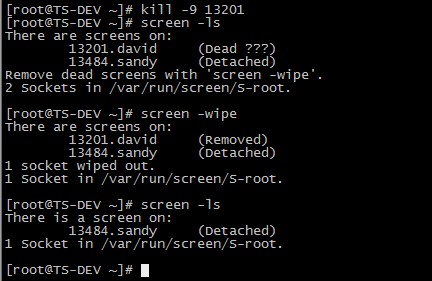 Screen's summary
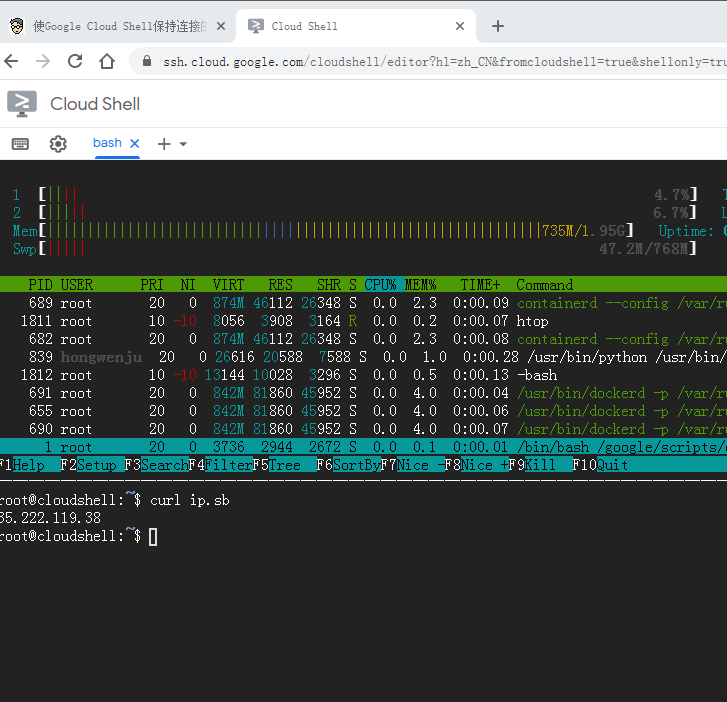 I'm gonna get you a new one, shell.cloud.google on the line.
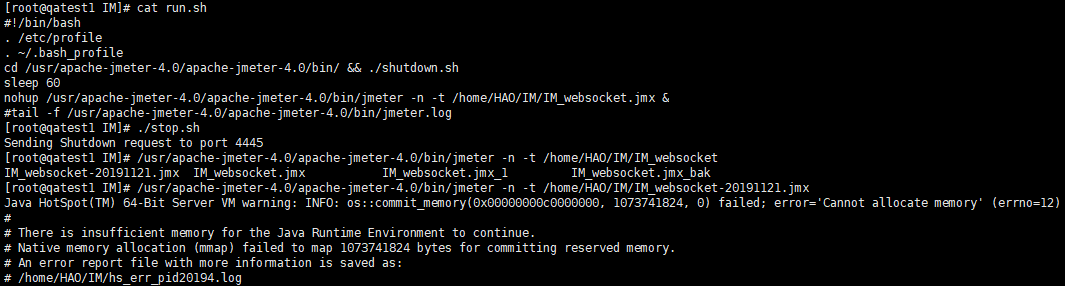 Linux Memory Clearing

