
 ">WeChat
tryhackme,RP:Burp Suite


Contents
- Preconditions
- Introduction
- Install
- Gettin'[CA]Authentication
- Function Overview
- Participation in Dark Modes
- Proxy
- Definition of objectives
- Duplicate all contents[er]
- Help! There’s an intruder!
- It turns out these machines are better than our math skills.
- Decoding and Comparator
- Install some Mod [Extender]
- But wait, there’s more!
- Extra credit
- Conclusions
Preconditions
Before you try this room, I strongly recommend that you look at it.NinjaJc01“. Web Basics Rooms。If you’re familiar with the basic Web request structure and SQL injection, then you have set it up!
Introduction
Today we’re going to try and finish the hiccup suite on the red floor. – If you want to try a link here, you can find it:https://tryhackme.com/room/rpburpsuite
Burp Suite is a framework for the Web application penetration testing tool, which is widely recognized as a de facto tool to be used in implementing Web applications tests. Throughout the conference room we will present basic knowledge of its installation and use, along with its main components.


Install
Before we go into the amazing tool of Burp Suite, we must first install it. Fortunately for us, if you have this room on Kali Linux, you will already have a Burp Suite.You’re okay.Yes.In case BurpSuite is installedUse deploy yourselfBrowser forInline computer!
If you want to install Burp from scratch (usually called Burp), you need to access this link:https : //portswigger.net/burp/communitydownload
#1
If you want to install Burp from scratch (usually called Burp), you need to access this link:https : //portswigger.net/burp/communitydownload
Number two.
Continue downloading the version of your operating system after entering Port Swigger to download the page
#3
Burp Suite needs Java JRE to run. Download and install Java here:https://www.java.com/en/download/
After all the settings are completed, hand over to our next task, get Gettin'[CA]Authentication!
Gettin'[CA]Authentication
We have to fix the certificate warning before we start using newly installed (or pre-installed) Burp Suite. We need to install CA certificates, because BurpSuite acts as a proxy between your browsers and sends them through the Internet — it allows the BurpSoite application to read and send HTTPS data.


A certificate warning will appear unless we install a CA certificate from Burp.
I’ll use Firefox and Foxy Proxy in this experiment.(maybeHere.Found. I used Firefox in this case, because it was easier to use Burp Suite.
#1
First, let’s move forward and start Burp. We can do this on Kali with a left icon. In the image below, it’s the 7th icon on the top of the left.If your Kali desktop does not look like the screenshot below, click Application and type Burp Suite. Click the Pop Suite icon that appears.


Start playing pp!
#2
When Burp is activated, the following screens will appear:


After pops up, click the Temporary Item, and then click the Next.
* You may have noticed now that both the “New items on disk” and the “Opening existing projects” appear as grey. As shown at the top of this window, saving items are functions associated with the Burp Suite Production because it is common to save and return for many days to test Web applications.
#3
Next, we will ask what configuration we want to use. Now, choose ” Use Bur default settings.”


Include this option because it is very useful to create a custom profile for proxy or other settings, especially depending on how your network is configured and/or whether you adopt, for example, the following:X11 ForwardOn Remote Startup of Burp Suite。
#4
Finally, let’s start Burp! Click “P” now!
#5
Now you will see a screen similar to the following:

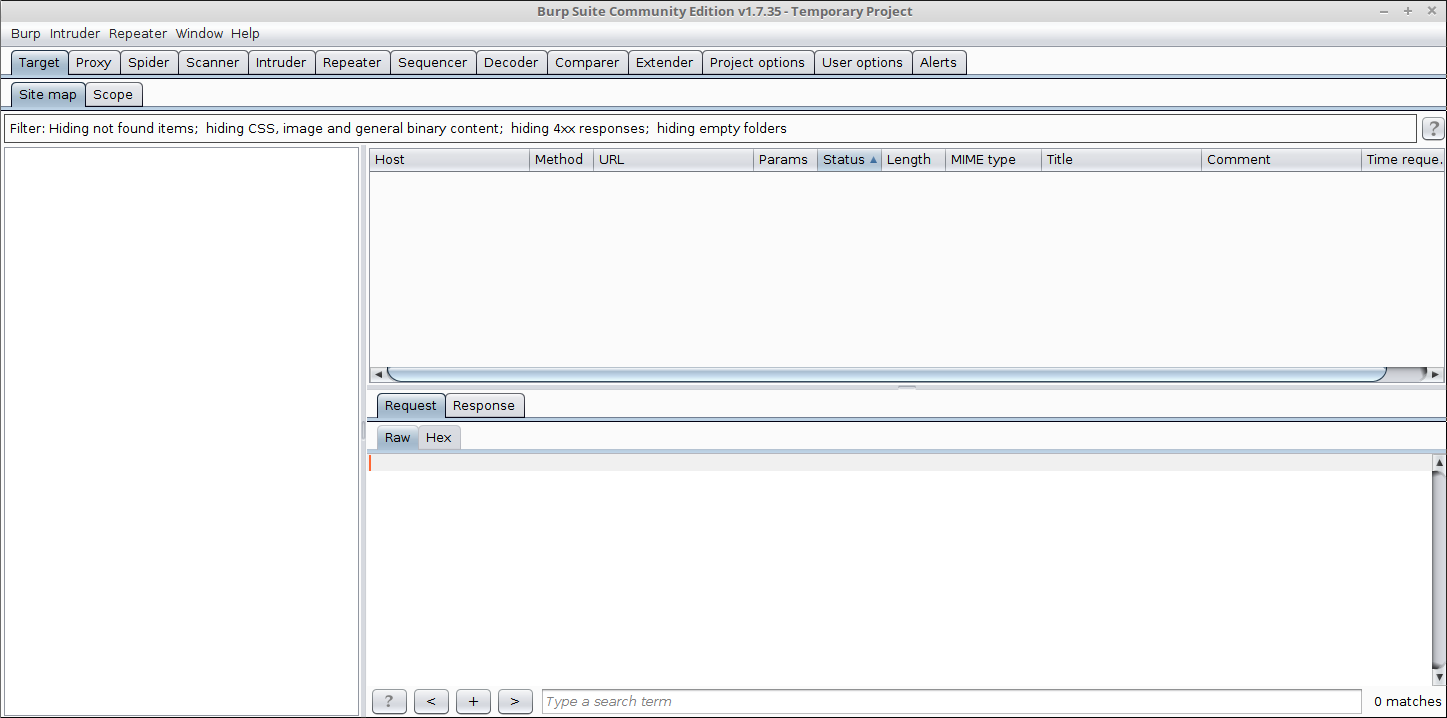
As we are now running the Burp Suite, it will be used by default to start the proxy service. In order to make full use of this agent, we must install the CA certificate accompanying Burp Suite (or we will not be able to load anything with SSL).
- You can do this part with your browser of choice, however, I’ll be using Firefox for this room. Burp suite latest update also comes with an inbuilt browser to skip installing the CA certificate.
#6
Now that we’ve started Burp, let’s add an extension to our web browser to allow up to easily route or traffic through it! For this room, we’ll be using ‘FoxyProxy Standard’ on Firefox.

Navigate to the following link to install FoxyProxy Standard: Link
Go ahead and install this now!
#7
Next, click on FoxyProxy among your extensions.


After that, click on ‘Options’.

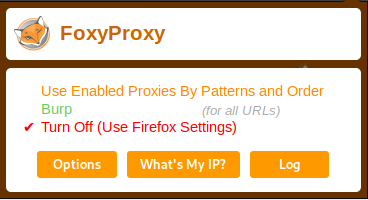
After that, click ‘Add’ in the top left.


Enter in the following settings and then click ‘Save’

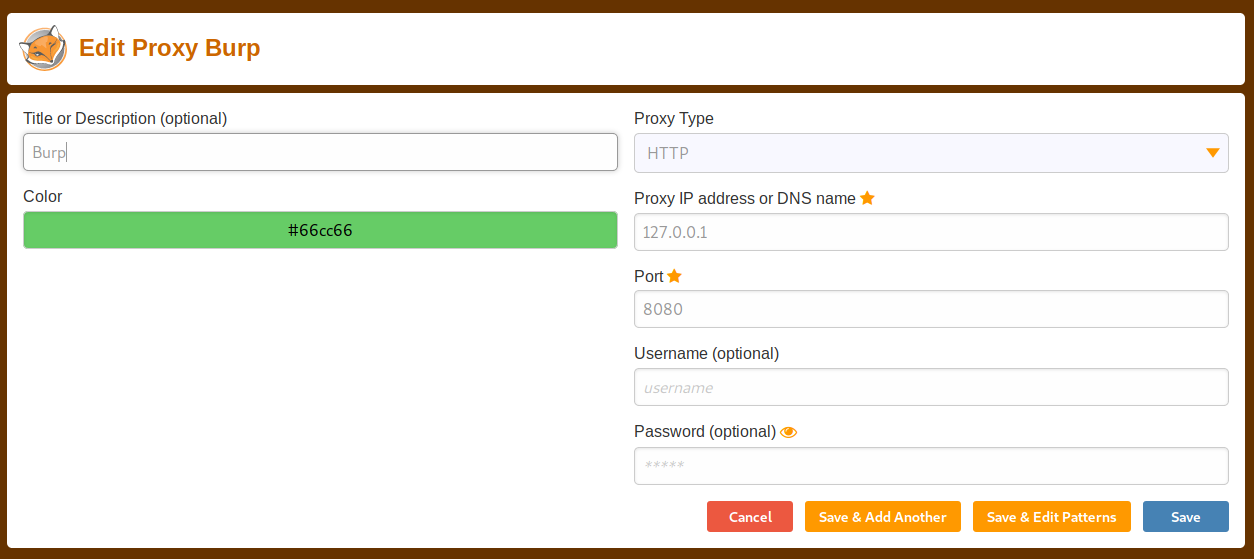
Finally, click on the FoxyProxy extension icon again and select ‘Burp’.

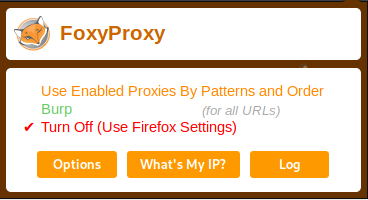
In the image above Burp isn’t selected. Make sure it is in yours!
Next, we’ll add the Burp certificate!
#8
Use Firefox to navigate to the following addresses:http:// localhost:8080
#9
You will see the following websites:

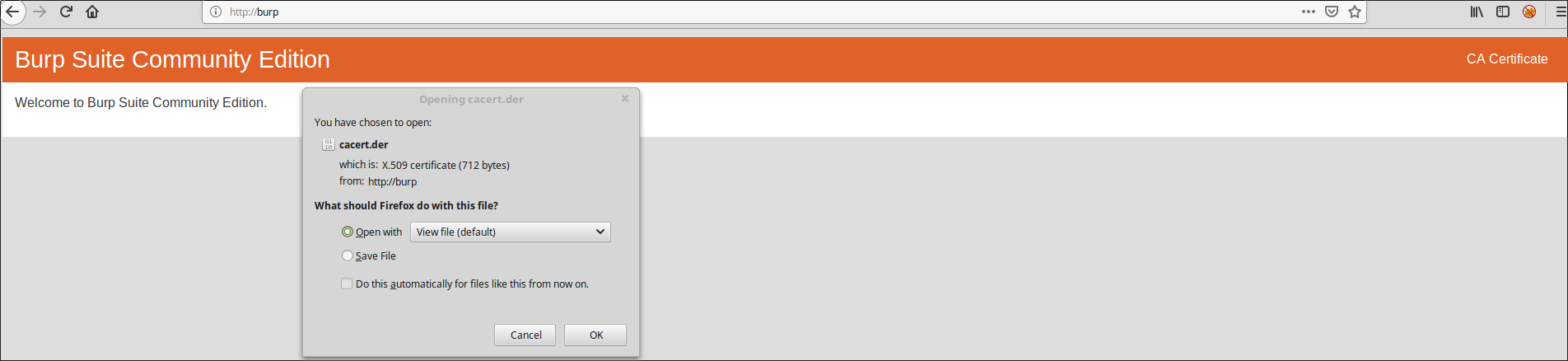
Click the CA certificate at the top right corner to download and save the CA certificate.
#10
Since we have downloaded CA certificates, please move to the Settings menu in Firefox. Search for Certificates in the search bar.


Click View Certificate
#11
Next, in Permissions tab click Import
#12
Navigates to the location where you saved our previously downloaded CA certificates. Select this certificate and click OK.
#13
Finally, select the following two options for display in this photograph:

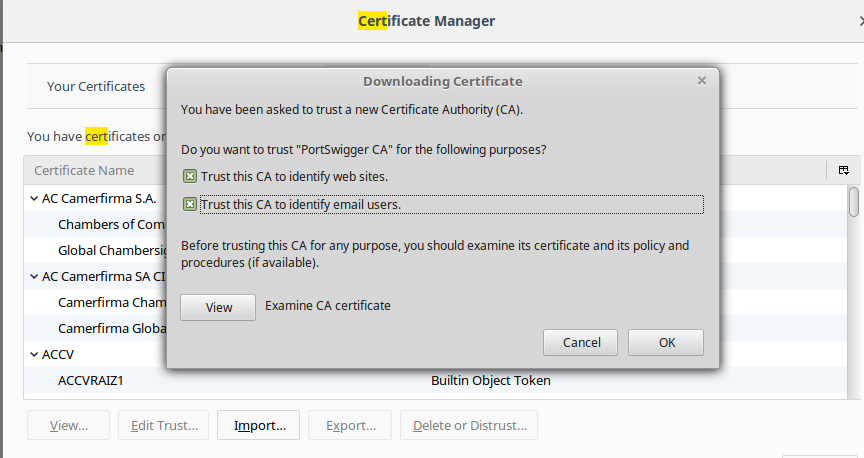
When this is done, choose “Certificate.” Congratulations, we have now installed the Burp Suite CA certificate!
Function Overview
Now that we’ve set up Burp, let’s take a look at everything it has to offer. Web application pentesting can be a messy affair but Burp has something for every step of the way.


Tools by Ana Miminoshvili on Dribbble
Throughout this room, we’ll be taking a look at these components of Burp Suite. Here’s a quick overview of each section covered:
- Proxy — What allows us to funnel traffic through Burp Suite for further analysis
- Target — How we set the scope of our project. We can also use this to effectively create a site map of the application we are testing.
- Intruder — Incredibly powerful tool for everything from field fuzzing to credential stuffing and more
- Repeater — Allows us to ‘repeat’ requests that have previously been made with or without modification. Often used in a precursor step to fuzzing with the aforementioned Intruder
- Sequencer — Analyzes the ‘randomness’ present in parts of the web app which are intended to be unpredictable. This is commonly used for testing session cookies
- Decoder — As the name suggests, Decoder is a tool that allows us to perform various transforms on pieces of data. These transforms vary from decoding/encoding to various bases or URL encoding.
- Comparer — Comparer as you might have guessed is a tool we can use to compare different responses or other pieces of data such as site maps or proxy histories (awesome for access control issue testing). This is very similar to the Linux tool diff.
- Extender — Similar to adding mods to a game like Minecraft, Extender allows us to add components such as tool integrations, additional scan definitions, and more!
- Scanner — Automated web vulnerability scanner that can highlight areas of the application for further manual investigation or possible exploitation with another section of Burp. This feature, while not in the community edition of Burp Suite, is still a key facet of performing a web application test.
#1
Which tool in Burp Suite can we use to perform a ‘diff’ on responses and other pieces of data?
comparer
#2
What tool could we use to analyze randomness in different pieces of data such as password reset tokens?
sequencer
#3
Which tool can we use to set the scope of our project?
target
#4
While only available in the premium versions of Burp Suite, which tool can we use to automatically identify different vulnerabilities in the application we are examining?
scanner
#5
Encoding or decoding data can be particularly useful when examining URL parameters or protections on a form, which tool allows us to do just that?
decoder
#6
Which tool allows us to redirect our web traffic into Burp for further examination?
proxy
#7
Simple in concept but powerful in execution, which tool allows us to reissue requests?
repeater
#8
Through four models, what tools can we use in Burp to achieve a variety of purposes, such as on-site fuzzy testing?
入侵者
#9
Last but not least, which tool allows us to modify Burp Suite by adding extensions?
补充剂
Participation in Dark Modes
The project is conducted late at night. Don’t be afraid! In this mission, we will introduce how to activate dark mode in the Burp Suite!


This task is optional. If you want to skip all the questions, just click ” Finish.” This part is simply intended to improve the quality of life when using Burp Suite throughout the conference room. You can see a dark pattern in question three of task eight.
#1
When you start the Burp Suite, let’s navigate first to the User Options tab.


#2
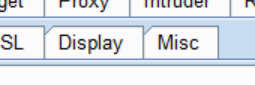
Next, click the Show sub-label.

#3
Now, click the Appearance drop-down menu. Select Darcula.

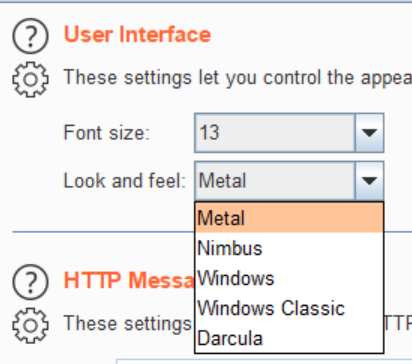
#4
Finally, close and restart the Burp Suite to give effect to the dark theme (or any subject of your choice).
Proxy
Generally, proxy servers are defined to enable us to relay traffic through alternative routes to the Internet. The reasons for doing so range from educational filtering (which often has to be done in schools where restricted content must be stopped) to access to content that is not available because of regional lock-in or bans. But by using agents to test Web applications, we can view and modify internal connections at fine particles.

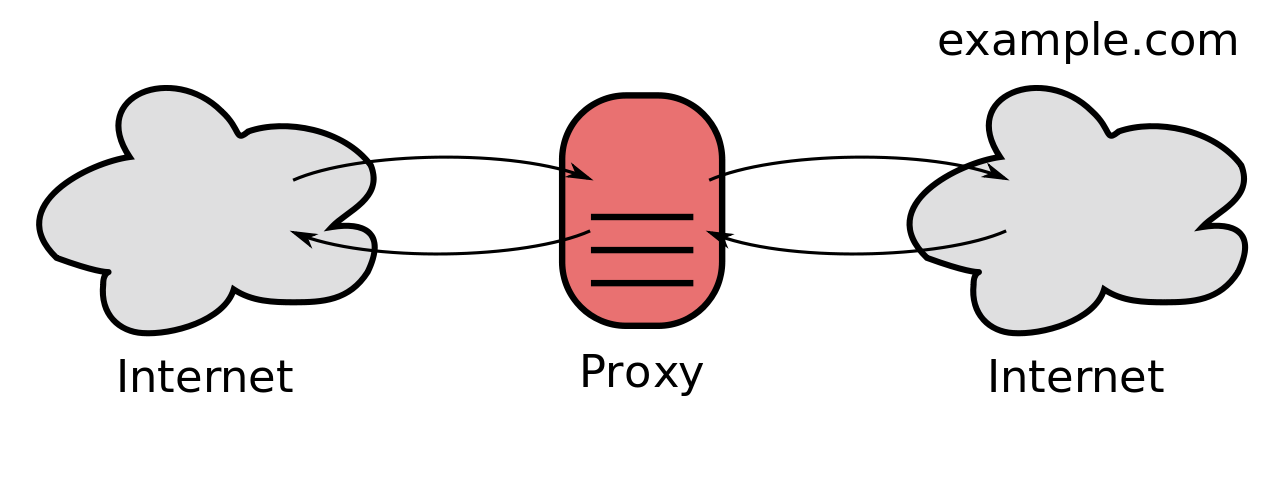
By proxy relays, basic diagrams of… Wikipedia — proxy server
Getting Gettin’s [CA]In the authentication task three, we configure network traffic as a route through the Burp Suite example. By default, “P” will be set to “stop” our flows. This means several things:
1. By default, the request will require our authorization.
2. We can modify our requests online and send them, as we saw in the middlemen ‘ s attacks.
3. We can also delete requests that we do not want to send. This is useful for seeing requests after clicking the button or doing other operations on the website.
4. Last but not least, we can send these requests to other tools such as Repeater and Intruder for modification and operation to induce loopholes.
Proxy Burp Suite reference document:Link
#1
Deployment of VM attached to this mission!
To complete this task, you need to passOpenVPNConnect to the TryHackMe network. If you useIt’s inside the browser.Computer, this is not necessary (but make sure that you are accessing the computer and using Burp inside the browser).
#2
By default, the Burp Suite agent is listening on only one interface. What is it?Use IP:PORT format
127.0.0.1:8080
#3
In the Burp Suite, Navigate to the ” Intercept ” sub-card in the ” Proxy ” section. Enable intercept
#4
Return to your web browser and navigate to the web application hosted on the VM we deployed just a bit ago. Note that the page appears to be continuously loading. Change back to Burp Suite, we now have a request that’s waiting in our intercept tab. Take a look at the actions, which shortcut allows us to forward the request to Repeater?
ctrl-R
#5
How about if we wanted to forward our request to Intruder?
ctrl-i
#6
Burp Suite saves the history of requests sent through the proxy along with their varying details. This can be especially useful when we need to have proof of our actions throughout a penetration test or we want to modify and resend a request we sent a while back. What is the name of the first section wherein general web requests (GET/POST) are saved?
http history
#7
Defined in RFC 6455 as a low-latency communication protocol that doesn’t require HTTP encapsulation, what is the name of the second section of our saved history in Burp Suite? These are commonly used in collaborate application which require real-time updates (Google Docs is an excellent example here).
websocket history
#8
Before we move onto exploring our target definition, let’s take a look at some of the advanced customization we can utilize in the Burp proxy. Move over to the Options section of the Proxy tab and scroll down to Intercept Client Requests. Here we can apply further fine-grained rules to define which requests we would like to intercept. Perhaps the most useful out of the default rules is our only AND rule. What is it’s match type?
URL
#9
How about it’s ‘Relationship’? In this situation, enabling this match rule can be incredibly useful following target definition as we can effectively leave intercept on permanently (unless we need to navigate without intercept) as it won’t disturb sites which are outside of our scope — something which is particularly nice if we need to Google something in the same browser.
is in target scope
Target Definition
Perhaps the most important feature in Burp Suite, we’ll now be turning our focus to the Target tab!


Lock on Target by Alexei Vella on Dribbble
The Target tab in Burp allows us to perform arguably some of the most important parts of a web application penetration test: defining our scope, viewing a site map, and specifying our issue definitions (although this is more useful within report generation and scanning).
When starting a web application test you’ll very likely be provided a few things:
– The application URL (hopefully for dev/test and not prod)
– A list of the different user roles within the application
– Various test accounts and associated credentials for those accounts
– A list of pieces/forms in the application which are out-of-scope for testing and should be avoided
From this information, we can now start to build our scope within Burp, something which is incredibly important in the case we are planning on performing any automated testing. Typically this is done in a tiered approach wherein we work our way up from the lowest privileged account (this includes unauthenticated access), browsing the site as a normal user would. Browsing like this to discover the full extent of the site is commonly referenced as the ‘happy path’. Following the creation of a site map via browsing the happy path, we can go through and start removing various items from the scope. These items typically fit one of these criteria:
– The item (page, form, etc) has been designated as out of scope in the provided documentation from the client
– Automated exploitation of the item (especially in a credentialed manner) would cause a huge mess (like sending hundreds of password reset emails — If you’ve done a web app professionally you’ve probably done this at one point)
– Automated exploitation of the item (especially in a credentialed manner) would lead to damaging and potentially crashing the web app
Once we’ve removed any restricted or otherwise potentially dangerous items from our scope, we can move onto other areas of testing with the various tools within Burp Suite.
Burp Suite reference documentation for Target: Link
#1
Before leaving the Proxy tab, switch Intercept to disabled. We’ll still see the pages we navigate to in our history and the target tab, just having Intercept constantly stopping our requests for this next bit will get old fast.
#2
Navigate to the Target tab in Burp. In our last task, Proxy, we browsed to the website on our target machine (in this case OWASP Juice Shop). Find our target site in this list and right-click on it. Select ‘Add to scope’.
#3
Clicking ‘Add to scope’ will trigger a pop-up. This will stop Burp from sending out-of-scope items to our site map.
#4
Select ‘Yes’ to close the popup.
#5
Browse the rest of the application to build our page structure in the target tab. After most pages on the site, return Burp Suite and expand the various levels of the application directory. How do we call this assembly of Web applications?
网站地图
#6
What are the terms for browsing applications as ordinary users before further examination?
幸福的道路
#7
Last thing you want to do before you go on. In the target tab, you may have noticed the defined sub-option card. Click now to enter.
#8
The problem definition found here is how Burp Suite defines the problems in the report. At the outset, these questions are particularly useful for understanding and classifying what we may have. What poisoning occurs when applications that are behind a high-speed cache process are not included in the high-speed cache key?
Web缓存中毒
Duplicate all contents[er]
By definition, Repeater allows us to repeat the requests that have been made. These can be reissued as they are or modified. Repeaters are usually used for experimental or more sophisticated development purposes than invaders and may not need automation in them. The purpose of our inspection is to find a conceptual proof that Juice Shop is vulnerable to SQL injections.


Burp Suite repeater reference document:Link
#1
First, you can navigate to the login page by clicking on the ” Account ” at the top right corner of Juice Shop (depending on the version of Juice Pop, possibly ” Login”.


#2
Try to use invalid proof of login. What’s wrong with failure?


无效的电子邮件或密码
#3
But wait, do we not want to send the request to Repeater? Even if we didn’t initially send it to Repeater by intercepting it, we can still find it in our history. Switch to the “HTTP” sub-option card. Browse for these requests until we have found a failed login attempt.Right-click this request, and then send it to Repeater and then send it to Intruder!

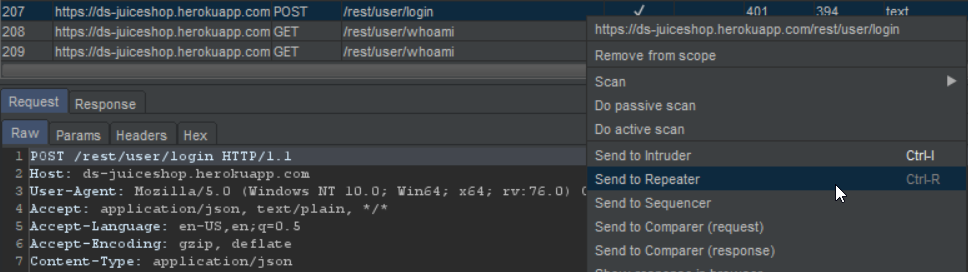
#4
Now we have sent the request to Repeater, so that we can try and adjust it so that we can send a single quote (‘) as an e-mail and password. What is wrong with this request?

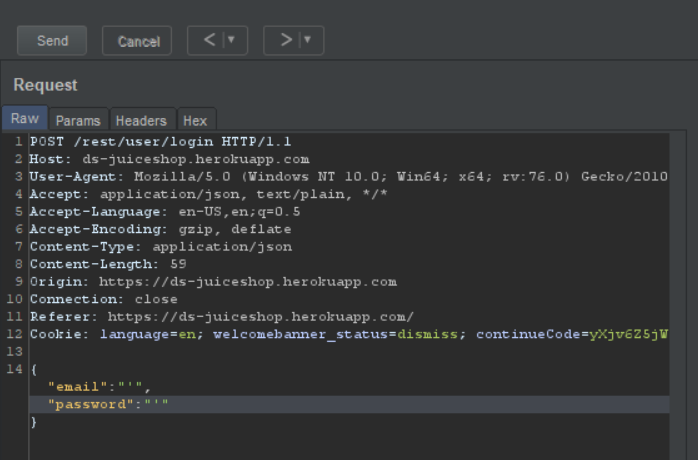
SQLITE_ERROR
#5
Now that we’ve leveraged Repeater to gain proof of concept that Juice Shop’s login is vulnerable to SQLi, let’s try something a little more mischievous and attempt to leave a devastating zero-star review. First, click on the drawer button in the top-left of the application. If this isn’t present for you, just skip to the next question.


#6
Next, click on ‘Customer Feedback’ (depending on the version of Juice Shop this also might be along the top of the page next to ‘Login’ under ‘Contact Us’)


#7
With the Burp proxy on submit feedback. Once this is done, find the POST request in your HTTP History in Burp and send it to Repeater.
#8
What field do we have to modify in order to submit a zero-star review?
rating
#9
Submit a zero-star review and complete this challenge in Juice Shop!
Help! There’s an Intruder!
Intruder can be described as the most powerful tool in Burp Suite, which can be used for many things ranging from fuzzy testing to violent deciphering. One of the central purposes of Intruder is automation.
Although Repeater can best conduct experiments or one-off tests, when the concept proves to be established, Intruder can do repeated tests.Burp Suite Document, some common usages are as follows:
– Element identifiers, such as user names, looping in predictable sessions/cipher restoration tokens and trying simple password guesses
– Collecting useful data from user profiles or other interested pages by repeating our responses
– Fuzzy detection holes, such as SQL injections, cross-site script (XSS) and file paths


In order to complete all these examples, the invader hasFour.Different types of attack:
1. Sniper. – The most popular type of attack, which circulates between the positions we choose and places in each position the next available payload (items from a word list). This is only used for one set of loads (a word list).
2. Battering Ram Unlike Sniper, Battering Ram uses only a set of payloads. Unlike Sniper, Battering Ram places each payload in every selected position. Consider how the hammer exposes large surfaces to individual surfaces, so the type of attack is named as a hammer.
3. Fork. – The type of forklift attack allows us to use multiple payloads (one selected per position) andAt the same timeTwo payload sets in an iterative fashion. For example, if we select two locations (for example, user name and password fields), you can provide a valid negative list of user names and passwords. The intruder then circulates the combination of user names and passwords, thus resulting in total grouping equal to the minimum payload set provided.
4. Cluster bombs – The type of cluster bomb attack allows us to use multiple payload sets (one in each location) and go through all the combinations of the payload lists we provide. For example, if we choose two locations (for example, user name fields and password fields), we can provide a valid negative listing form for both user names and passwords.Please note that if you use the Burp community version, this could be a long time.

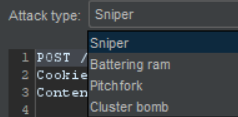
Intruder attack type selection
For our purposes, we will return to the holes that were injected by using SQLs previously discovered through the use of Repeater.
For some additional practice on using Intruder, check out the older Learn Burp Suite room here on TryHackMe
Burp Suite reference documentation for Intruder: Link
#1
Which attack type allows us to select multiple payload sets (one per position) and iterate through them simultaneously?
sniper
#2
How about the attack type which allows us to use one payload set in every single position we’ve selected simultaneously?
battering ram
#3
Which attack type allows us to select multiple payload sets (one per position) and iterate through all possible combinations?
cluster bomb
#4
Perhaps the most commonly used, which attack type allows us to cycle through our payload set, putting the next available payload in each position in turn?
sniper
#5
Download the wordlist attached to this room, this is a shortened version of the fuzzdb SQLi platform detection list.
#6
Return to the Intruder in Burp. In our previous task, we passed our failed login attempt to both Repeater and Intruder for further examination. Open up the Positions sub-tab in the Intruder tab with this request now and verify that ‘Sniper’ is selected as our attack type.


#7
Burp attempts to automatically highlight possible fields of interest for Intruder, however, it doesn’t have it quite right for what we’ll be looking at in this instance. Hit ‘Clear’ on the right-hand side to clear all selected fields.


#8
Next, let’s highlight the email field between the double quotes (“). This will be whatever you entered in the email field for our previous failed login attempt.


#9
Now, click Add to select the location of our e-mail field as a payload.


#10
Next, let’s switch to the Intruder payload tab. When you get there, click Load and select a list of words that you have previously downloaded in question 5, which has been added to this task.

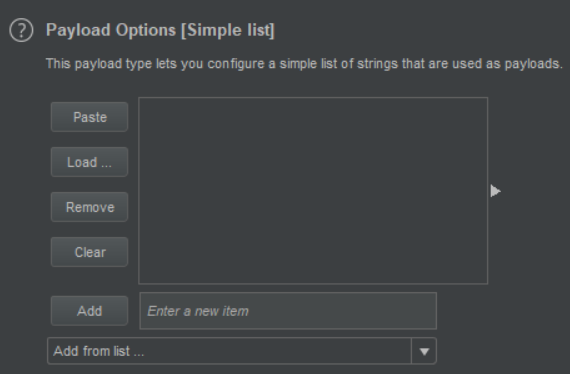
#11
Almost! Scroll down and uncheck the ” URL Encoding These Characters.” We do not want characters sent in the payload to be encoded, because otherwise they will not be recognized by SQL.


#12
Finally, what is the first payload to click on “Start attack.” Return to the 200 status code (which indicates that we have successfully bypassed authentication)?
a'或1 = 1--
It turns out that in math, machines are better than us.
Although less commonly used in the practice environment, Sequencer represents a core tool in appropriate Web application penetration testing.According to the Burp DocumentBurp’s Sequencer is a tool for analysing randomity in the message boards of applications and other important data items, which could not have been predicted. Some of the projects analysed frequently include:
– A meeting token.
– Anti-CSRF tokens.
-Cyptonial reshuffle token (send with password reset, which theoretically binds the user to their unique request for reshuffle)
We’ll quickly explore how to use Sequencer to check the session cookies sent by Juice Shop.


Maxime Bourgeois uses Angular Universal for SEO friendly incremental Web application on Dribbble
Burp Suite reference documentation for Sequencer: Link
#1
Switch over to the HTTP history sub-tab of Proxy.
#2
We’re going to dig for a response which issues a cookie. Parse through the various responses we’ve received from Juice Shop until you find one that includes a ‘Set-Cookie’ header.
#3
Once you’ve found a request response that issues a cookie, right-click on the request and select ‘Send to Sequencer’.
#4
Change over Sequencer and select ‘Start live capture’
#5
Let Sequencer run and collect ~10,000 requests. Once it hits roughly that amount hit ‘Pause’ and then ‘Analyze now’
#6
Parse through the results. What is the effective estimated entropy measured in?
bits
#7
In order to find the availability of entropy, we often have to make some adjustments in order to have a standardized data set.
代币
#8
Read the rest of the token analysis
Decoding and Comparator
While code decoders and comparators are secondary tools in the Burp Suite, understanding and use of them remains essential for becoming skilled Web application testers.
By definition, decodors are tools that allow us to convert data. These transformations range from decoded/encoding to various bases or URL codes. We link these conversions together and whenever we choose the decodor, encoder or Hash, Decode automatically creates an additional layer.Ultimately, the tool’s functionality andCyber ChiefIt’s very similar.Although it’s a little less functional.


Muriel’s encryption on Dribbble.
Similarly, Comparer, as you might have guessed is a tool we can use to compare different responses or other pieces of data such as site maps or proxy histories (awesome for access control issue testing). This is very similar to the Linux tool diff.
Per the Burp documentation, some common uses for Comparer are as follows:
– When looking for username enumeration conditions, you can compare responses to failed logins using valid and invalid usernames, looking for subtle differences in responses. This is also sometimes useful for when enumerating password recovery forms or another similar recovery/account access mechanism.
– When an Intruder attack has resulted in some very large responses with different lengths than the base response, you can compare these to quickly see where the differences lie.
– When comparing the site maps or Proxy history entries generated by different types of users, you can compare pairs of similar requests to see where the differences lie that give rise to different application behaviour. This may reveal possible access control issues in the application wherein lower privileged users can access pages they really shouldn’t be able to.
– When testing for blind SQL injection bugs using Boolean condition injection and other similar tests, you can compare two responses to see whether injecting different conditions has resulted in a relevant difference in responses.
*These examples are taken nearly in their entirety from the Burp docs simply to provide a broader set of examples to consider when using Comparer.


#1
Let’s first take a look at decoder by revisiting an old friend. Previously we discovered the scoreboard within the site JavaScript. Return to our target tab and find the API endpoint highlighted in the following request:

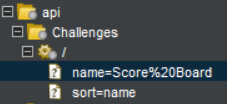
#2
Copy the first line of that request and paste it into Decoder. Next, select ‘Decode as …’ URL
#3
What character does the %20 in the request we copied into Decoder decode as?
space
#4
Similar to CyberChef, Decoder also has a ‘Magic’ mode where it will automatically attempt to decode the input it is provided. What is this mode called?
smart decode
#5
What can we load into Comparer to see differences in what various user roles can access? This is very useful to check for access control issues.
site maps
#6
Comparer can perform a diff against two different metrics, which one allows us to examine the data loaded in as-is rather than breaking it down into bytes?
words
Installing some Mods [Extender]
Similar to adding mods to a game like Minecraft, Extender allows us to add components such as tool integrations, additional scan definitions, and more! Here are some of the most popular extensions I suggest checking out (not all of these are free but I suggest looking into them all the same):
- Logger++ — Adds enhanced logging to all requests and responses from all Burp Suite tools, enable this one before you need it 😉
- Request Smuggler — A relatively new extension, this allows you to attempt to smuggle requests to backend servers. See this talk by James Kettle for more details: Link
- Autorize — Useful for authentication testing in web app tests. These tests typically revolve around navigating to restricted pages or issuing restricted GET requests with the session cookies of low-privileged users
- Burp Teams Server — Allows for collaboration on a Burp project amongst team members. Project details are shared in a chatroom-like format
- Retire.js — Adds scanner checks for outdated JavaScript libraries that contain vulnerabilities, this is a premium extension
- J2EEScan — Adds scanner test coverage for J2EE (java platform for web development) applications, this is a premium extension
- Request Timer — Captures response times for requests made by all Burp tools, useful for discovering timing attack vectors


Contributing by Matt Scribner on Dribbble
A prerequisite for many of the extensions offered for Burp, we’ll walk through the installation of Jython, the Java implementation of Python.


Burp Suite reference documentation for Extender: Link
Article on some of the top extensions for Burp Suite: Link
#1
To start, let’s go ahead and switch over to the Options sub-tab of the Extender tab.
#2
Scroll down until you reach the ‘Python Environment’ section. Note, Burp requires the standalone edition of Jython.
#3
Download the standalone version of Jython from here: Link — I suggest saving this or moving it to your Documents folder
#4
Returns the Burp and click Select File under the Python Environment sub-section of Jython Standalone. Navigate to where you have just downloaded this file and select it.
#5
Burp can now be used to install the extension. Switch to the BApp Store sub-card of Extender and browse through the various extensions provided.
#6
Which extension allows us to add bookmarks for various requests?
书签
But wait, there’s more!
Before summing up, let’s get a quick look at the functionality provided by Burp Suite Production: The Burp Suite scanner and the collaborators client!


Todd Zlab’s engagement at Dribbble.
In the mission-based model of Burp 2.0, we can activate these scans (scanners and spiders) from the dashboard and allow them to run backstage while continuing to check Web applications. In this case, I have run an unidentified scanning on Juice Shop that is attached to this task. These reports can provide a starting point for further enumeration and use through other tools in Burp Suite.

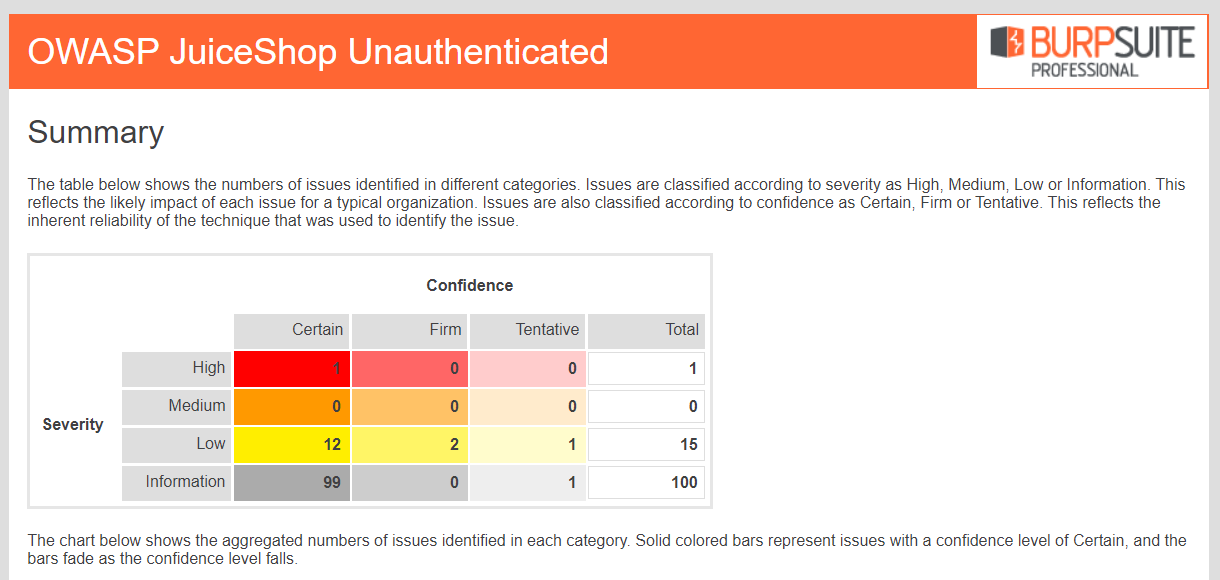
Preview of the report attached to this task created by the Burp Production
Burp Collaborrator Clinic is usually used for manual testing, which allows us to gain insight into problems that may not produce any results. Normally, during the testing process, we may encounter projects that are likely to be vulnerable to attack because of the slow time/speed or lack of response from Web applications, but do not produce any definite indicators. But, with the help of Burp Collaborator, we can generate external alerts by generating payloads that could help us return to Burp Suite’s server.


Applicable toScannerandCollaborrator client. Burp Suite reference document
#1
Download the report attached to this mission. What is the only key question?
跨域资源共享:可信任任意源
#2
How many “some” low-level problems did Burp find?
12
Extra credit
You’re lucky to know more? Burp Suite’s manufacturer Port Swigger owns (mostly) free online Web Security Academy! This online training is very well suited for learning more about Web development techniques and using your new Bump skills in testing.It’s free.The only exception is that some laboratories need a Burp Suite specialized version.
Here you can find Port Swiger Web Security Academy:https ://portswigger.net/web-security


In addition to Port Swiger training, SANS offers excellent Web application penetration testing. Some of these include SANS SEC 542andSEC 642Note that these training courses are expensive and can be quite expensive. Nevertheless, they are of incredible quality and worth testing.


Last but not least, you can continue to study in the room of TryHackme.Link


#1
View the links provided and continue to learn!
Conclusions
Read more about how to intercept and modify the data sent to an outside site. We have learned how to check certain loopholes by entering changes, and how to submit various payloads to a website.
未经允许不得转载:萌萌Apprentissage » tryhackme--RP:Burp Suite


 learn NMAP

